Custom website design vs a template: what you are buying
A template is a finished argument with your name swapped in. Its sections exist in an order, each with a job, and that order was decided for a business whose objection was not yours.
So the first cost is recognisability. Templates are popular in proportion to how good they are, which means the best ones are also the ones your competitors bought. In a category where five suppliers get compared in one afternoon, looking like the other four is not neutral.
The second is the ceiling on the design itself. Every template has a shape it cannot make, and you find it in month two, halfway through a page that will not do the thing the page needs.
The third is the one nobody warns you about, and it is the expensive one.
The trap: the slots write the copy
A template gives you three feature boxes, so you write three features. Four testimonial slots, so you find four testimonials. A statistics strip, so you go looking for statistics.
None of those decisions were made about your business. They were made about a layout, and now the layout is deciding what your argument contains — which is exactly backwards from message first, structure second, screens third.
The tell is a page where every section is filled and none of it is specific. Nothing is wrong with it, and no sentence on it could only have been written about you.
Custom design does not automatically avoid this. A designer who starts from a reference site has bought the same trap with extra steps. What avoids it is deciding the argument before the sections exist.
When a template is the right answer
When the site is not how you get found. If the business runs on referrals, contracts or a sales team, the website is a credential and a template one is a perfectly good credential.
When you have not decided what the site is for yet. A template is a cheap way to find out, and finding out is worth more than the page you replace afterwards.
When the budget is genuinely small. A well-chosen template with real copy beats a custom design with placeholder thinking at any price, and this is the case where the honest advice is to spend the money elsewhere.
In all three, buy the template and spend the saved money on the words. That is the trade that actually pays.
When it stops being enough
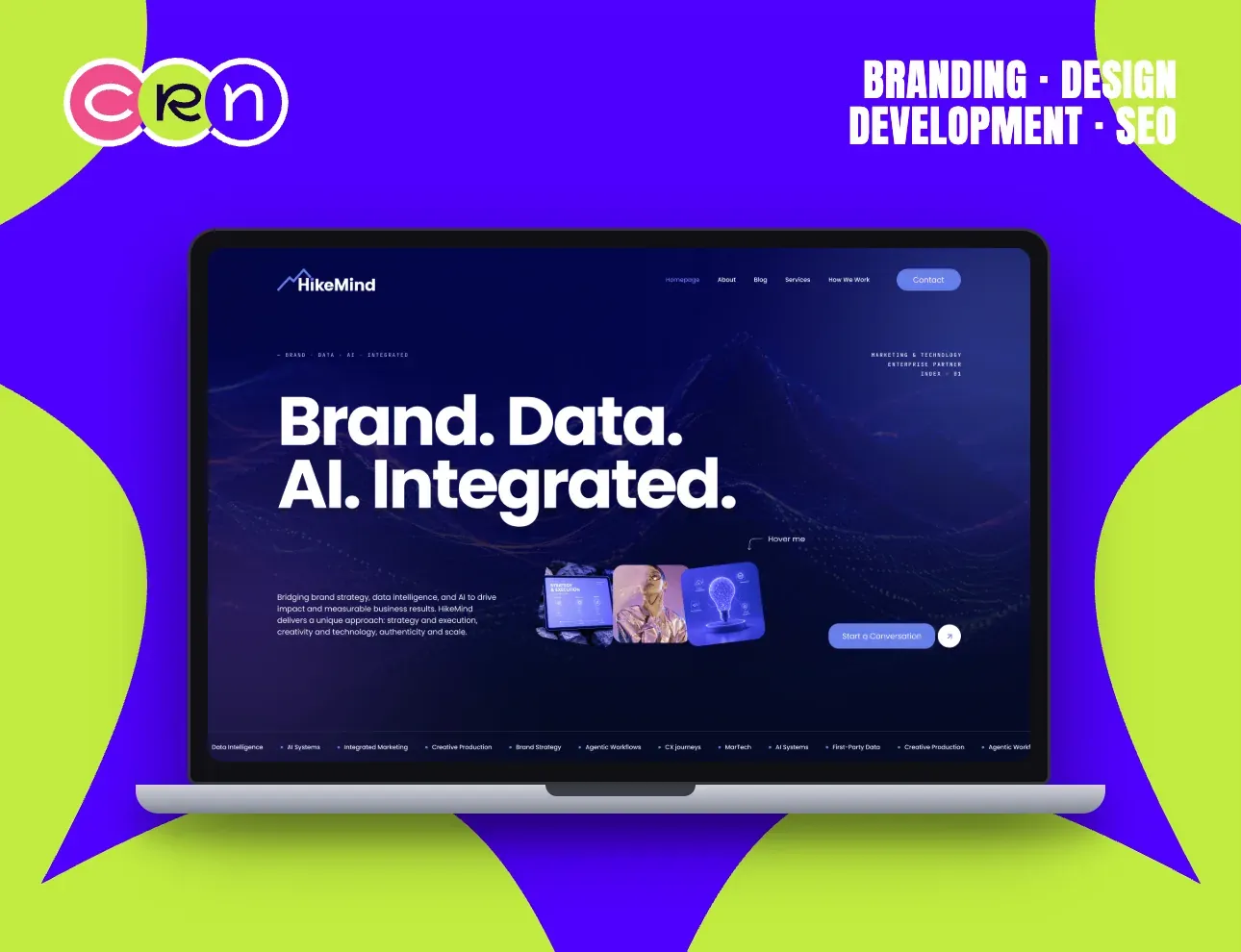
HikeMind had to hold a whole positioning in four words: brand, data, AI, integrated. They are set as four sentences rather than a list, so each one lands on its own, and the background is a data-drawn mountain range — the company's name made literal, in the dark.
There is no template slot for that. Not because it is elaborate, but because the composition is the argument: the words say the disciplines are integrated, and the picture is the proof, and a three-column feature grid cannot make that claim no matter what you type into it.
That is the threshold. Not when a template stops looking good, but when what you need to say stops fitting into the shapes it offers — which is usually the same year the site became how people find you, and the same year a builder starts to feel tight.
Questions we get asked
Is a custom website design worth it over a template?
It is worth it when the website is how customers find you, when your positioning depends on not looking like your category, or when what you need to say does not fit the shapes a template offers. If none of those is true, a good template with real copy is the better buy.
What is wrong with using a website template?
Nothing, until the slots start writing your copy. A template with three feature boxes produces three features whether or not your argument has three parts, and the result is a page where everything is filled and nothing is specific to you.
How much more does custom design cost than a template?
A template is tens of dollars and a custom design is a project, so the multiple is large and the comparison is misleading. The real comparison is a template plus the work of adapting it honestly, against a design made for your argument. The gap is smaller than the sticker price suggests and larger than zero.
Can you customise a template enough to look original?
You can change the colours, the type and the images and still be recognisable to anyone who has seen the original, because what identifies a template is its structure. Change the structure enough to fix that and you have paid for a custom design in instalments.