Custom CRM development: when building wins
When your process is the product. If how you move a deal through its stages is the thing that makes the business better than its competitors, encoding it in someone else's model flattens the advantage. The tool starts telling you how to sell, and that is the wrong way round.
When the objects do not fit. Every CRM ships with contacts, companies and deals. If your world is really vessels, permits and inspections — with rules about which can exist without the others — you will spend years bending custom fields around a shape that was never yours.
When the integration bill exceeds the build. Some businesses need the CRM to be the thin layer over four systems that already exist. Past a certain point the connectors, the sync failures and the reconciliation cost more than owning the middle would have.
Three genuine cases. If none of them is yours, the maths is not close: an off-the-shelf CRM costs a fraction of a build and arrives on Tuesday.
The reasons that look like those and are not
“It does not fit how we work.” Sometimes true, and more often the tool was set up in a hurry two years ago and never revisited. A week with someone who actually knows the product is a cheaper experiment than a build, and it settles the question either way.
“The licences are expensive.” Compare honestly: seats against a build, plus hosting, plus the person who maintains it, plus the features you will rediscover one at a time. Off-the-shelf tools look expensive until you price the thousand small things they already do.
“We want to own our data.” You can export from every serious CRM, and an API is not the same as a lock-in. Ownership is a real concern in a small number of regulated cases and a slogan in most of the others.
“The team will not use it.” A build will not fix that. Adoption is a process problem wearing a software costume, and new software is the most expensive way to avoid the conversation.
The hybrid that usually wins
Buy the CRM, build the part that is actually yours. Keep contacts, deals, email and reporting where they already work, and build the one workflow that carries your advantage as a thin application beside it, talking to the CRM through its API.
It is cheaper by an order of magnitude, it fails in smaller pieces, and it leaves you an exit: if the custom part turns out to be wrong, you have not also lost your contact database.
It is the same line we draw between a marketing site and an application — platform for the part that is standard, custom for the part that holds your logic — and it holds here for the same reason.
The test for what goes on which side: would a competitor buying the same off-the-shelf tool get the same result? If yes, it belongs in the tool. If no, that is the part worth building.
Where the work actually is
Not the screens. The migration, the permissions and the reporting, in that order, and none of them appear in a demo.
Migration means the data you have, in the state it is actually in: duplicates, half-filled records, the three years where somebody used the notes field as a database. It is the least glamorous line in the project and reliably the largest.
Permissions mean deciding who can see what before anyone builds a screen, because retrofitting an access model into a finished system is close to rebuilding it. It is one of the four drivers of what an app costs and it is the one people leave until last.
Reporting means agreeing what the numbers mean while it is still a conversation. Two people in the room will define an active client differently, and finding that out after the dashboard is built is how dashboards end up mistrusted.
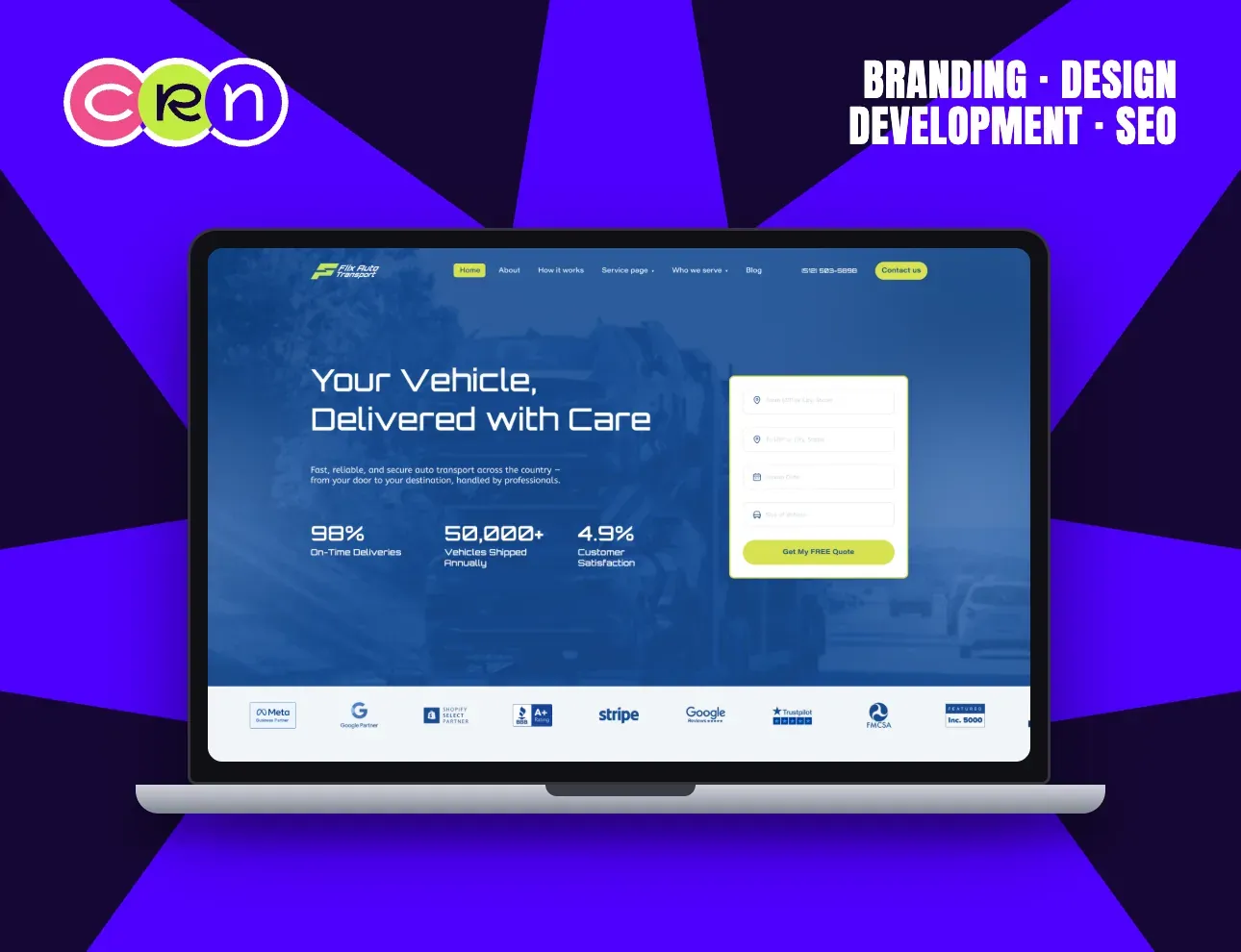
Flix Auto Transport publishes three numbers on its homepage: 98% on-time deliveries, 50,000+ vehicles shipped annually, 4.9 satisfaction. Numbers like those are only publishable because something behind the business counts them the same way every time, and agreeing what each one means is exactly the work this section is about. The site is the visible end of it.
Questions we get asked
Should we build a custom CRM or buy one?
Buy, unless one of three things is true: your sales process is itself the competitive advantage, your core objects genuinely do not fit contacts-companies-deals, or the cost of integrating the systems you already run exceeds the cost of owning the middle. Otherwise an off-the-shelf tool wins on price, time and everything it already does.
How much does a custom CRM cost to build?
It is an application, so it is priced like one: who logs in, what the system holds, what it connects to. Expect the build to be the smaller half of the total once migration, permissions and reporting are included, and expect the maintenance to be permanent rather than occasional.
Can we customise an off-the-shelf CRM instead?
Usually, and it is the first thing to try. Custom fields, pipelines and automations cover a great deal of what teams believe requires a build. The signal that you have genuinely run out of room is not frustration — it is having to store something important in a field that means something else.
What is the biggest risk in a custom CRM project?
The data migration, every time. Records are always messier than anyone remembers, and a system launched on top of bad data gets abandoned in month three no matter how good the software is. Budget it as a real workstream with a real owner.